
I suspect Naledi might tell this story differently. So, perhaps you should take my version with a pinch of salt. We were courting, and I had already made up my mind that I wanted to marry this girl. She had introduced me to her family, and that had gone well. They seemed to like me. Now it was my turn to take her to the Eastern Cape to meet my family. We took a bus. A long journey lay ahead of us, and I thought this would be a wonderful opportunity to talk about our future. We could speak about our love for each other, our hopes, and the kind of family we wanted to build.
But there were a few things I wanted to straighten out before we tied the knot. Two of them were homemaking and homeschooling. I had already thought through the kind of marriage and family life I desired. I wanted my wife to be a homemaker, and I wanted our children to be homeschooled. The problem was that Naledi was not particularly excited about either idea. And, being the wise young man I thought I was, I decided that a nine-hour bus journey would be the perfect place to raise the subject! I probably should have waited until we had at least passed Vereeniging. Instead, I brought it up before we had even left Gauteng. I remember the conversation not going particularly well. Strangely, though, my overall memory of that trip is a happy one. I cannot quite remember how we recovered from that conversation, but somehow we did.
And ten years later, here we are. Naledi is a homemaker. She homeschools our children. And what began as something she was not particularly enthusiastic about has become something she has grown to love. But there is much more to this story.
The Conviction Was Mine, but the Work Was Hers
I have written elsewhere about why we homeschool. We believe that parents are responsible before God for raising their children in the discipline and instruction of the Lord. We have chosen classical Christian education because we want our children to learn to think carefully, read deeply, appreciate what is true, good and beautiful, and ultimately see all of life under the lordship of Christ. We know homeschooling is not commanded of every Christian family. Faithful Christian parents may educate their children differently. But for our family, this has become an important conviction.
And yet there is something I must confess. For a long time, I was more committed to the idea of homeschooling than I was to supporting the person doing it. I remember hearing Paul Washer challenge husbands who proudly say, “We homeschool.” His point was that sometimes it is actually the wife doing the homeschooling while the husband takes credit for the family conviction. That convicted me. Because that was me. I had introduced the idea. I had explained the theology. I had persuaded my wife of its value. But Naledi was doing the daily work. And I was not always paying attention.
“You Don’t Even Ask How School Went”
I remember our arguments during the early days of homeschooling. Naledi would sometimes ask why I never bothered to find out how school had gone. I would come home from work and not ask what the children had learned, what had been difficult, or how she had managed the day. In my mind, I trusted her. I suppose my attitude was something like, I trust you. Do your thing, girl! But what I considered trust could sometimes feel like indifference. Naledi was carrying the responsibility of educating our children, and I was not showing sufficient interest in the work she was doing.
It took time for me to see that. By God’s grace, I have grown in this area. But I wish I had understood earlier that supporting my wife meant more than agreeing with her educational philosophy. It meant taking an interest in her day. It meant asking questions. It meant recognising that teaching children is work. And it meant remembering that these were our children, not merely her pupils.
Then I Became the Teacher
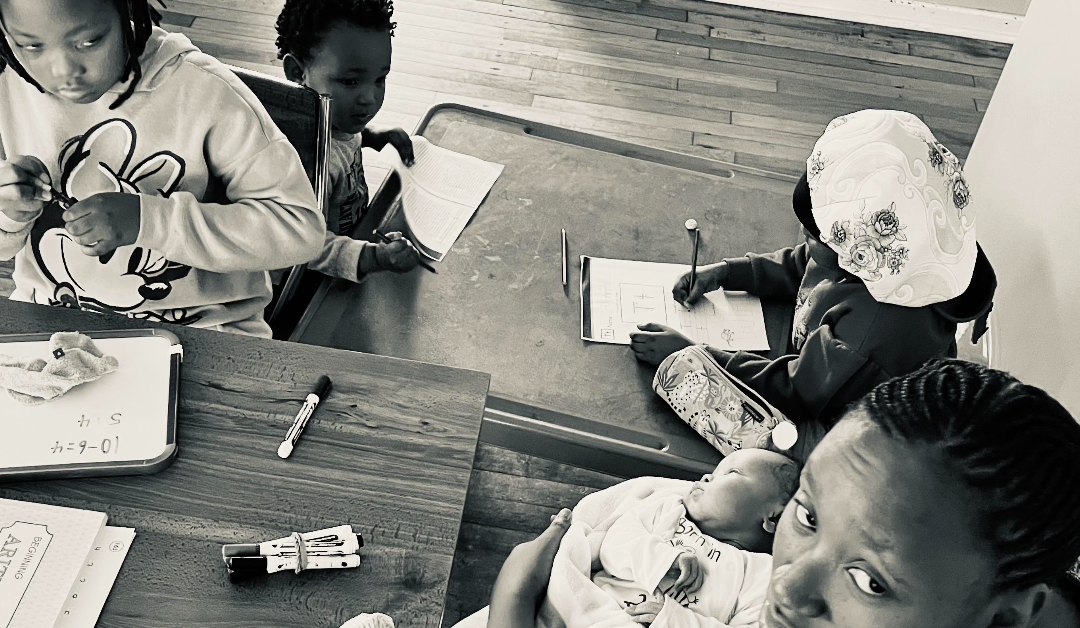
For the past few months, I have been without work. Our circumstances have changed considerably, and we also welcomed another baby into our family. This has meant that I have had to take a much more active role in homeschooling. Zenande is eight, working through the transition from Grade 1 to Grade 2. Alu has begun Grade R. Then there is Chulu, our energetic two-year-old boy, who has absolutely no intention of allowing anyone to forget that he is present. And, of course, there is baby Qhawe.
Now, let me tell you something. Homeschooling requires preparation. You cannot simply wake up, gather the children around the table, and expect a productive school day. There are lessons to prepare the night before. There is reading, writing, mathematics, and all the other subjects that make up a classical education. One child needs help understanding something. Another finishes early. Someone needs the toilet. Someone is hungry. Someone cannot find a pencil. And just when you think everyone is finally settled, Chulu has a different plan for the morning. All this while there is a baby in the house! I have found myself doing things that require what feels like superhuman strength. And then I remember. Naledi has been doing this. For years.
I See the Teacher Differently Now
There is something humbling about doing another person’s work. You begin to notice things that were invisible to you before. I now understand something of the patience required to teach a child who does not immediately understand a lesson. I understand how exhausting it can be to repeat the same instruction several times. I understand why preparation matters. And I understand how one difficult morning can leave you feeling that you have accomplished very little, even when you have worked incredibly hard. Homeschooling is not simply about teaching children their letters and numbers. It is about shaping habits, cultivating attention, correcting attitudes, encouraging perseverance, and helping young minds learn to love what is good. It is a slow work. Much of its fruit may only become visible years later. And for much of our children’s lives, Naledi has been the one doing this work. Not before an audience. Not with applause. But around our table.
A Work That Matters to God
One of the dangers of Christian ministry is that we can begin to think of important work mainly in terms of what happens publicly. A sermon preached. A Bible study taught. An article published. A conference addressed. These things matter. But so does a mother patiently teaching her child to read. So does correcting a child who is being unkind. So does answering questions about God while preparing lunch. So does returning to the same mathematics lesson for the third time because a child has not yet understood it.
Scripture tells us that parents are to teach God’s words diligently to their children, speaking of them in the ordinary rhythms of life (Deuteronomy 6:6–7). And Paul reminds us that whatever we do, we are to work heartily, as for the Lord (Colossians 3:23). That includes the work done around a dining table. Christian education is not merely about producing clever children. We want our children to know the Lord, love the truth, grow in wisdom, and use their minds and abilities to serve him. But none of our efforts can give them new hearts. Only Christ can save them. That is why even our educational convictions must continually bring us back to the gospel. We labour faithfully, knowing that the fruit belongs to God.
Something I Would Tell My Younger Self
If I could go back to that bus journey, I would still want to have the conversation about homeschooling. But I would have it differently. I would listen more carefully. I would ask Naledi what she thought, what concerned her, and what she would need from me if we ever took that path. And I would tell my younger self something I have learned in the years since: Brother, do not be so committed to your convictions that you forget to carry the responsibilities that come with them.
It is easy to say that you want a Christian home. It is harder to help build one. It is easy to talk about classical Christian education. It is harder to sit beside a child who is struggling to understand a lesson. And it is easy to admire a faithful wife while leaving her to carry burdens you should be sharing. Husbands, our leadership must never become an excuse for our absence. Christ loved the church and gave himself up for her (Ephesians 5:25). That is the pattern of Christian husbandhood. Not merely having a vision for our families, but giving ourselves in love for them.
Answer Number Two
Naledi, you have asked me many times: “Why did you choose me?” Here is my second answer. Because you have given yourself faithfully to the work of teaching and shaping our children. I know you did not begin this journey with the same enthusiasm I had. In fact, I still smile when I think about that bus journey. But somewhere along the way, the conviction became yours too. And you did not merely embrace it in theory. You embraced it in practice. You prepared lessons. You taught. You corrected. You encouraged. You persevered through difficult days. You did all this while carrying the many other responsibilities of our home. And for too long, I did not appreciate it as I should have.
These past few months have given me the privilege of experiencing something of what you have been doing. I am grateful for that. Not merely because I have learned more about homeschooling, but because I have learned more about you. I have watched you become a teacher. And now, having spent more time in your place at our table, I appreciate the teacher you have become. I don’t know what our children will eventually become. Perhaps one will be a teacher. Perhaps another a doctor. Perhaps one will serve the Lord in ministry. Perhaps their lives will take directions we cannot presently imagine. But whatever they become, I pray they will remember the woman who patiently helped lay the foundations of their learning. And I pray that, above everything else, they will come to know and love the Saviour whom we have sought to place at the centre of their education.
Naledi, on that bus journey many years ago, I was trying to explain the kind of family I wanted us to have. I did not yet understand how much of that vision would be carried by you. I understand a little better now. So thank you, my love. Thank you for the lessons prepared. For the difficult mornings. For the patience. For the unseen labour. For the love. And thank you for reminding me that some of the most important work God gives us happens not before a congregation, but around an ordinary family table. That is my second answer. And I am grateful to God that I chose you.
Lord we thank you for such union
It’s only by the grace of God Sisi wam.